How blimp camera photography actually works
A blimp camera platform is a bag of helium with fins, a line to the ground, and a camera hung underneath. Nothing about it is complicated. What is demanding is the set of eight conditions that all have to hold at the same moment, and the order in which a crew makes them hold.
A tethered blimp is an aerostat: a craft that stays up because it displaces more air than it weighs, not because anything is spinning. It is non rigid, which is what the word blimp means in aeronautics. There is no internal frame. The hull holds its shape only because the gas inside it sits at a slightly higher pressure than the air outside, the way a beach ball does. Take the pressure away and the whole thing becomes a sheet of fabric.
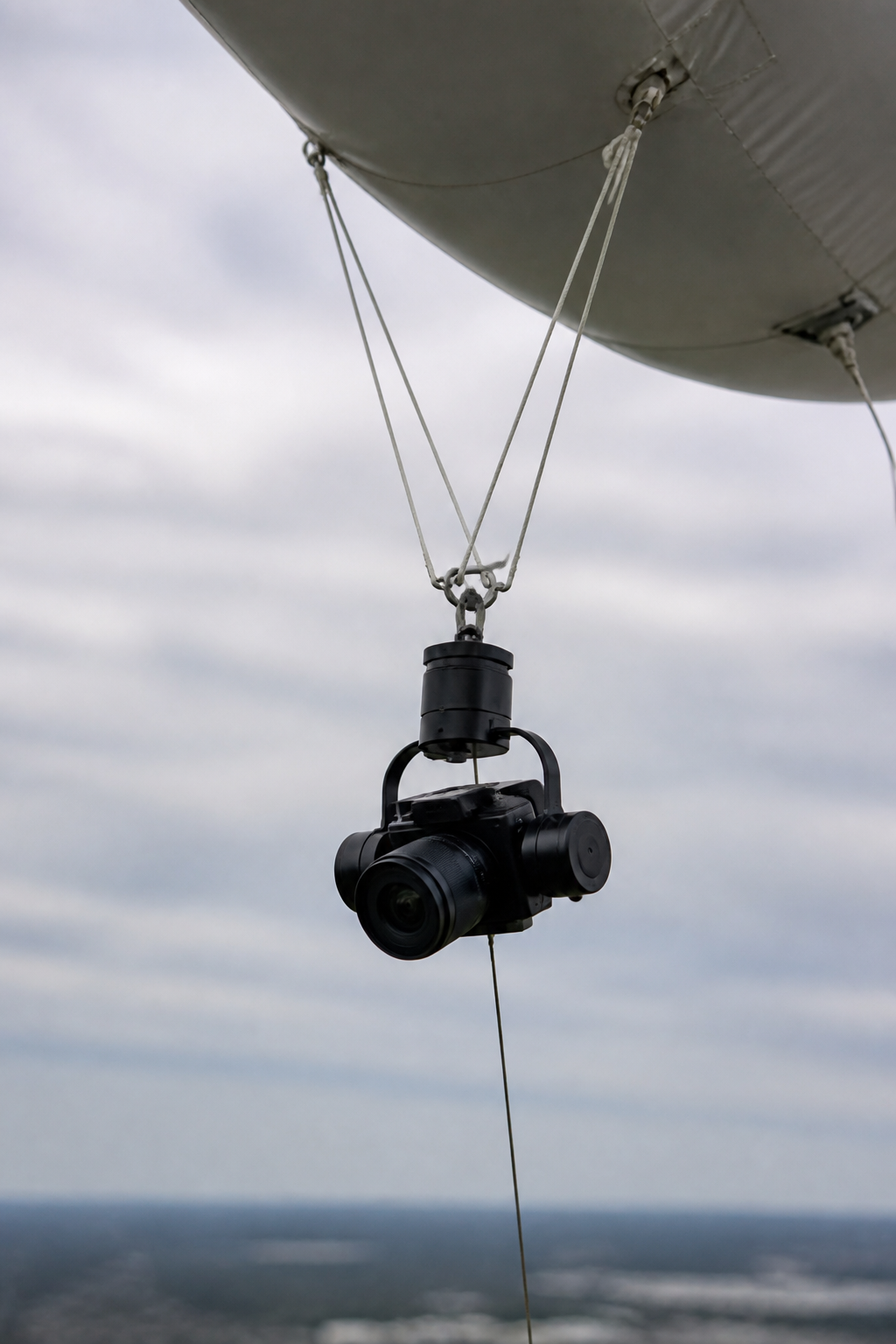
For photography the hull is usually somewhere between two and eight metres long, filled with helium, and shaped rather than spherical. The shape earns its cost twice: a streamlined body of revolution has a fraction of the drag of a sphere of the same volume, and the fins at the back make it weathervane, so it points into the wind instead of rolling around the sky. A camera pod hangs from a bridle under the hull, and a single line runs down to a winch on the ground.
- Lifting gas
- Helium, about 1.05 kg per cubic metre of net lift at sea level
- Working band
- Roughly 30 to 500 feet above the surface
- Endurance
- Limited by weather and gas loss, not by battery
- Ground crew
- Two people minimum, three when the line is long
The lift budget comes first
Everything else on a tethered platform is downstream of one number. At the sea level reference conditions of the International Standard Atmosphere, air weighs 1.225 kilograms per cubic metre and helium weighs 0.1786. The difference, close to 1.05 kilograms per cubic metre, is what a cubic metre of helium can lift.1 In United States units that is about 0.065 pounds per cubic foot, which is a discouraging figure the first time you meet it: a thousand cubic feet of helium, a volume the size of a small van, lifts about sixty five pounds before you subtract anything.
You then subtract quite a lot. The envelope fabric, the fins, the seams and patches, the bridle, the part of the tether the balloon has to carry, and the camera pod itself all come out of that gross figure. What is left over is called free lift, and free lift is the only thing standing between the platform and the wind. A hull flown with almost no margin will sink at the first gust, because the gust both pushes it sideways and increases the load on the line.
| Item | Mass | Comment |
|---|---|---|
| Envelope and fins | 3.5 kg | Coated fabric hull of about 14 cubic metres |
| Bridle and rigging | 0.6 kg | Lines, patches, swivel, snap hooks |
| Tether carried | 0.5 kg | Roughly 300 feet of 3 mm line, part of it resting on the ground |
| Camera pod | 4.0 kg | Body, lens, remote head, battery, video link |
| Total load | 8.6 kg | Everything the gas has to hold |
| Gross lift | 14.7 kg | 14 cubic metres of helium at sea level |
| Free lift | 6.1 kg | The margin that keeps the hull up in moving air |
Two things quietly eat that margin during a session. Helium diffuses through fabric, slowly but continuously, so a hull inflated on Monday does not have Monday's lift on Thursday. And lift is proportional to the density of the surrounding air, so the same envelope lifts less on a hot afternoon, at altitude, or on a day of low pressure. Crews weigh the platform before the first ascent rather than trusting the previous session's figure.
The tether decides the altitude, and the wind decides the tether
On a still morning the line goes straight up and the altitude equals the length paid out. That morning is rare. As soon as there is wind, the platform sits downwind at an angle, and the geometry is unforgiving: if the line is straight and makes an angle with the ground, the height reached is the length of the line multiplied by the sine of that angle. At sixty degrees you keep 87 per cent of your line. At forty five degrees you keep 71 per cent. At thirty degrees you have paid out three hundred feet of tether to reach one hundred and fifty.
Wind does not push a tethered camera sideways. It pushes it down, and it takes the picture you came for with it.
The blowdown problem in one line
That angle is set by the ratio of two forces: the free lift pulling up and the aerodynamic drag pushing back. Drag grows with the square of the wind speed, so a wind that doubles from six to twelve knots does not double the load on the line, it roughly quadruples it.2 This is the single reason a shaped hull is worth its price over a plain sphere, and the reason crews watch the forecast for gust spread rather than for average wind.
The line itself is thin and strong, typically a high modulus polyethylene braid of two to four millimetres. At that diameter it weighs on the order of five grams per metre, so three hundred feet of it is about half a kilogram, which is why the tether appears in the lift budget above. Federal rules add their own requirements to the line: coloured pennants at intervals of no more than fifty feet, starting one hundred and fifty feet above the surface, so that the tether is visible to anything else in the air.3
Aiming a camera you cannot see through
The camera sits in a remote head, usually two axis: pan and tilt. Roll is normally handled by the bridle, which hangs the pod level, rather than by a motor. A video link sends a low resolution live view down to a monitor at the winch, and a small controller drives the head, the shutter and sometimes a zoom. On simpler rigs there is no live view at all: the operator sets an interval and shoots continuously while the platform drifts through the arc it is going to drift through anyway, then discards nine frames out of ten.
What the operator does not control is position. A tethered platform is not flown, it is placed. Height comes from the winch, bearing comes from where the crew stands, and everything else is negotiation with the wind. Moving the shot twenty feet to the left means walking the whole ground station twenty feet to the left, which on a fenced construction site can be an hour of work or simply impossible. This is the central difference from a multirotor, and it is covered on its own page.
The eight conditions
A frame from a tethered platform is worth keeping when all of the following are true at the same instant. In practice a session is the process of getting them to overlap.
- the hull has enough free lift for the wind actually blowing, not the wind forecast;
- the tether angle still puts the camera at the height the picture needs;
- the pod has stopped swinging after the last adjustment, which takes longer than people expect, often fifteen to thirty seconds;5
- the shutter speed is short enough that residual angular motion stays under one pixel;
- the sun is where the subject needs it, which on a building is a window of minutes;
- the airspace requirement for the site has been satisfied, including any advance notice;
- nothing has entered the exclusion area under the platform, since anything that falls, falls straight down;
- the crew has enough helium left to hold position for the rest of the sequence.
What a session looks like from the ground
Inflation happens first and it is the least photogenic part of the day. The envelope is laid out downwind of the cylinders, filled slowly enough that the fabric does not snap, and then weighed off: ballast is added or removed until the platform has the intended free lift and no more. Over inflation is a real hazard, because gas expands as the platform rises and the relief valve, not the fabric, has to be what gives way.
The pod goes on next, level, with the bridle adjusted so the camera hangs square. Then the platform is walked to the launch point and let up in stages, with a pause every fifty feet or so to check that the line is running clean and the video link is holding. Federal rules require a moored balloon to carry a device that deflates it automatically and rapidly if it ever escapes its moorings, and that device is checked on the ground, not in the air.4
Recovery is inflation in reverse and is the moment most damage happens. A hull that has been stable for three hours becomes unpredictable in the last thirty feet, where it enters the turbulent, gusty air near buildings and trees. Crews bring it down fast through that layer and slow everywhere else.
Where the method fails
Three failure modes account for most abandoned sessions. Wind above roughly twelve to fifteen knots at the working height, which is often much more than the wind at head height. Sites with no clear ground footprint, because the tether needs a corridor and the area beneath the platform has to stay clear. And time pressure, because inflation, weigh off and recovery are close to fixed costs whether the camera takes ten frames or ten thousand.
Against that, the method has three things nothing else does as well: it will hold a position for hours without a battery change, it will carry a payload heavier than most small unmanned aircraft can lift, and it makes almost no noise and no propeller wash, which matters indoors, in wildlife work and in occupied buildings.
Those trade offs are the whole subject. They are set out side by side, with the regulatory ceilings that constrain both platforms, in the comparison of drones and tethered aerostats, and the physics summarised here is worked through properly in the page on lift, drag and tether geometry.
Notes
- Densities at 15 degrees Celsius and 1013.25 hectopascals, the sea level reference conditions of the International Standard Atmosphere: dry air 1.225 kg per cubic metre, helium 0.1786 kg per cubic metre. The difference is 1.046, rounded here to 1.05. Back
- Standard drag equation: force equals one half of air density, times velocity squared, times the drag coefficient, times the reference area. Only the velocity term changes during a session, and it is squared. Back
- Marking of mooring lines: 14 CFR 101.17. The rule also sets lighting requirements for operations between sunset and sunrise. Back
- Rapid deflation device: 14 CFR 101.19, which also requires the operator to notify the nearest air traffic control facility immediately if a balloon escapes and the device does not work. Back
- Settling time after an adjustment is a pendulum problem: the period depends on the distance from the pod to the effective point of suspension, so a longer bridle swings more slowly and takes longer to stop. Back