Drone or blimp: what the difference is really made of
The multirotor won this argument around 2013 and it deserved to. But it won on cost, speed and positioning, not on every axis, and the axes it lost still describe real work: hours of station keeping, heavy payloads, silence, and rooms with a ceiling.
Before 2013 a camera at two hundred feet meant a crane, a helicopter, a very long mast or a bag of gas. The first mass market camera multirotors arrived that year, the regulatory framework for commercial flight in the United States followed in August 2016, and within two seasons the tethered platform had lost the general case.1 Anyone comparing the two today is not asking which is better. They are asking whether their job is one of the exceptions.
The honest way to run the comparison is criterion by criterion, with the regulatory ceilings stated rather than assumed, because those ceilings differ and they are not the ones most people expect.
- Moored balloon ceiling
- 500 feet above the surface, under 14 CFR Part 101
- Small unmanned aircraft ceiling
- 400 feet above ground, under 14 CFR Part 107
- Aerostat endurance
- Hours, limited by weather and gas loss
- Multirotor endurance
- Typically 20 to 45 minutes per battery
The comparison, criterion by criterion
| Criterion | Tethered aerostat | Small multirotor |
|---|---|---|
| Legal ceiling | 500 ft above the surface | 400 ft above ground, or 400 ft above a structure when within 400 ft of it |
| Endurance | Hours, gas and weather permitting | 20 to 45 minutes per battery |
| Payload | Set by envelope volume, easily several kilograms | Limited by thrust and by the 55 lb total weight cap |
| Positioning | Not steerable, placed by winch and by where the crew stands | Repeatable to metres, or to centimetres with a survey grade receiver |
| Wind limit | Low, commonly ten to fifteen knots at working height | Higher, many airframes rated around twenty knots |
| Setup and recovery | Inflation, weigh off and packing, close to a fixed cost | Minutes |
| Ground footprint | Anchor, winch, tether corridor and a clear area beneath | A take off point |
| Noise and wash | Silent, no propeller wash | Audible, with downwash under the airframe |
| Consumables | Helium, which does not come back | Batteries, which recharge |
| Indoors | Practical in large volumes | Possible but noisy and hazardous near people |
| Long exposures | Good once the pod has settled | Poor, vibration and drift |
| Failure mode | Deflation or a runaway hull on a broken line | An uncontrolled descent under the aircraft |
Two rows in that table are worth expanding, because they are where most of the practical difference lives.
Placed against flown
A multirotor is flown. It holds a coordinate, returns to it after a gust, and can repeat the same position on a later visit closely enough that two images taken months apart overlay. That repeatability is the reason it took over progress documentation and survey work almost entirely. A tethered aerostat is placed: its height comes from the winch, its bearing from where the anchor is, and its actual position from the wind. Move the picture and you move the ground station.
One machine goes where you tell it. The other goes where the wind agrees to leave it, and then stays there all afternoon.
The trade in a sentence
Endurance, and what it is worth
Battery endurance is not usually the constraint people imagine. A twenty five minute flight is ample for a set of stills, and swapping batteries costs a minute. Endurance matters when the subject, not the photographer, sets the timing: a ceremony that starts late, a concrete pour that runs long, a weather window you are waiting for, a wildlife observation that has to be uninterrupted. In those cases a platform that can sit at two hundred feet for four hours without a single interruption is doing something a multirotor genuinely cannot.
That is also the reason large tethered aerostats remain in service for surveillance and communications relay, where dwell time is the entire point and no one cares that the platform cannot move.2 Camera work simply inherits a small version of the same argument.
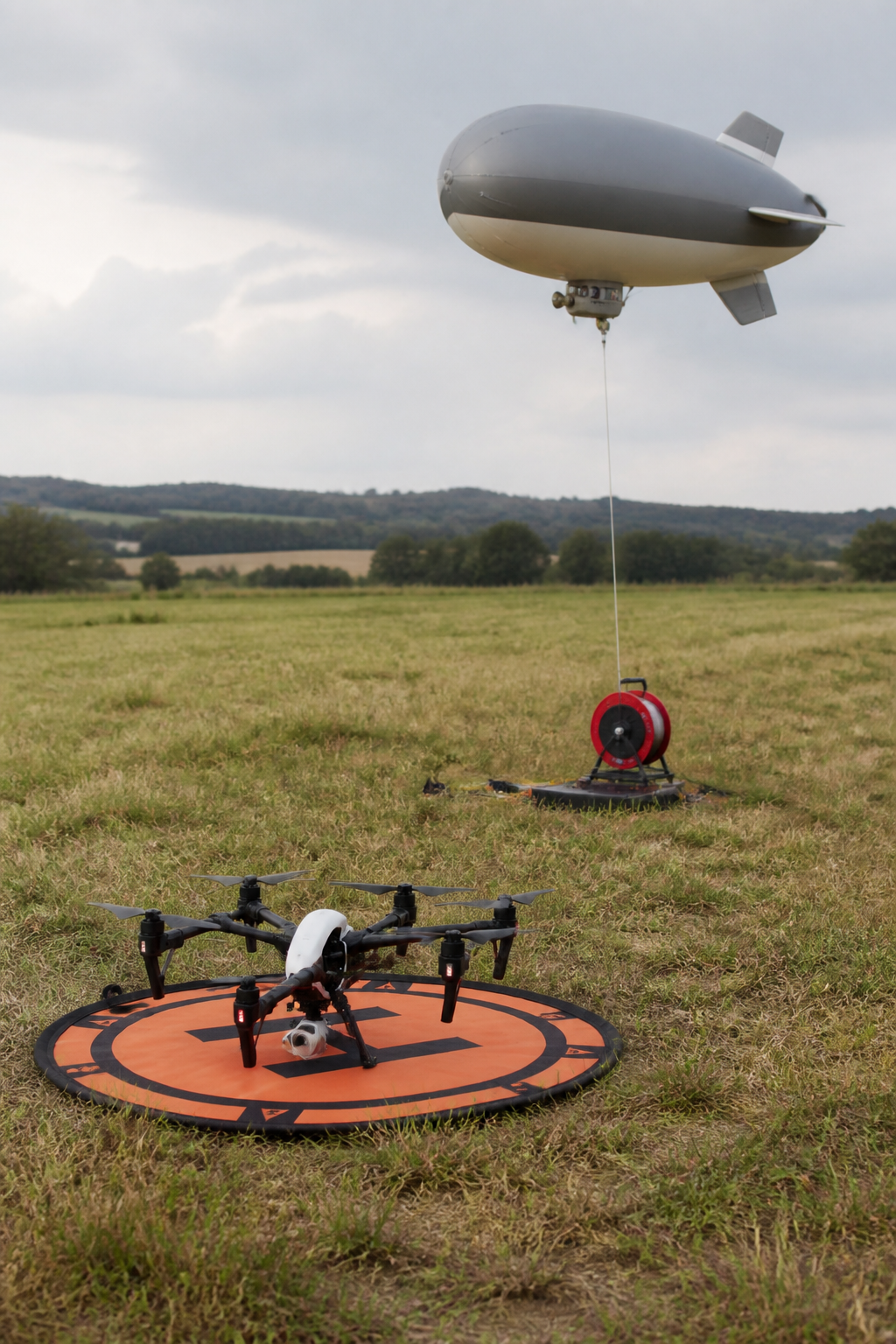
The rules are not symmetrical
It surprises people that the balloon has the higher ceiling. Part 101 caps a moored balloon or kite at five hundred feet above the surface, while Part 107 caps a small unmanned aircraft at four hundred feet above ground level, with the well known exception that it may go four hundred feet above a structure when it stays within four hundred feet of that structure.3
The asymmetry runs the other way on everything else. A drone operator holds a remote pilot certificate and can obtain airspace authorisation for controlled airspace, often in minutes, through the automated system. A tethered crew has no equivalent: Part 101 keeps them well clear of airports, requires advance notice to air traffic control above a certain height, and asks for pennants on the line and a device that deflates the balloon if it escapes. The paperwork is smaller and the geographic restrictions are larger. Both regimes are set out on the airspace page.
When the tethered platform is still the right answer
- the camera has to stay in one place for hours rather than minutes;
- the payload is heavier than a small airframe will lift, or needs to hang absolutely still;
- the exposure is long, at dusk or at night, and propeller vibration is unacceptable;
- the venue is indoors, or the subject is noise sensitive;
- the position wanted is a fixed one that the crew can reach on foot, and precision matters less than dwell.
And when it is not: anything that needs to be repeated on a schedule from an exact coordinate, anything on a site with no ground room, anything on a windy day, anything with a two hour window including travel. Which, honestly, is most commissions. That is what the market decided, and the decision was correct.4
Notes
- The first widely sold ready to fly camera multirotors appeared in 2013. In the United States, 14 CFR Part 107 took effect on 29/08/2016, replacing the case by case exemption process that preceded it. Back
- Large tethered aerostats are flown for days at a time for radar and communications work, at altitudes and volumes far beyond anything used for photography. Back
- Ceilings: 14 CFR 101.13 for moored balloons and kites, 14 CFR 107.51 for small unmanned aircraft. Both are subject to waivers and authorisations that this page does not attempt to summarise. Back
- Written as an observation about which platform gets bought, not as advice about any particular job. Back