A short history of the camera on a string
Aerial photography began tethered, stayed tethered for half a century, and returned to a tether every time aircraft proved too fast, too high or too expensive for the picture somebody wanted. The multirotor is the first platform to answer all three objections at once.
The first aerial photographs were made from balloons because there was nothing else to make them from. Gaspard Felix Tournachon, the Parisian photographer and caricaturist who worked as Nadar, took a camera up over Petit Bicetre near Paris in 1858 and produced what is generally accepted as the first aerial photograph. The plates have not survived.1 He had already patented the idea of photographing from the air for surveying and mapmaking three years earlier, which tells you that the commercial application was understood before the technique worked.
Two years later, over Boston, James Wallace Black went up with the balloonist Samuel Archer King and made an image that did survive. It is the oldest aerial photograph still in existence, taken in October 1860 from about twelve hundred feet, and it carries the title Boston as the Eagle and the Wild Goose See It.2 Every constraint in the present day version of this craft is visible in it: the exposure is long, the platform is drifting, and the sharpest part of the frame is the part directly below.
| Year | What happened | Platform |
|---|---|---|
| 1858 | First known aerial photograph, near Paris, since lost | Balloon |
| 1860 | Boston from the air, the oldest surviving aerial photograph | Balloon |
| 1888 | First kite aerial photograph, in southern France | Kite |
| 1906 | Panorama of San Francisco after the earthquake | Train of kites |
| 1908 | A camera small enough to be carried by a pigeon is patented | Bird |
| 1915 | Streamlined observation balloons enter wide military service | Tethered balloon |
| 1930s | Photogrammetric mapping from aircraft becomes routine | Aircraft |
| 1980s | Cable suspended cameras appear over sports fields | Cable array |
| 2013 | Ready to fly camera multirotors reach the mass market | Multirotor |
| 2016 | The United States commercial small drone rule takes effect | Multirotor |
The kite decades
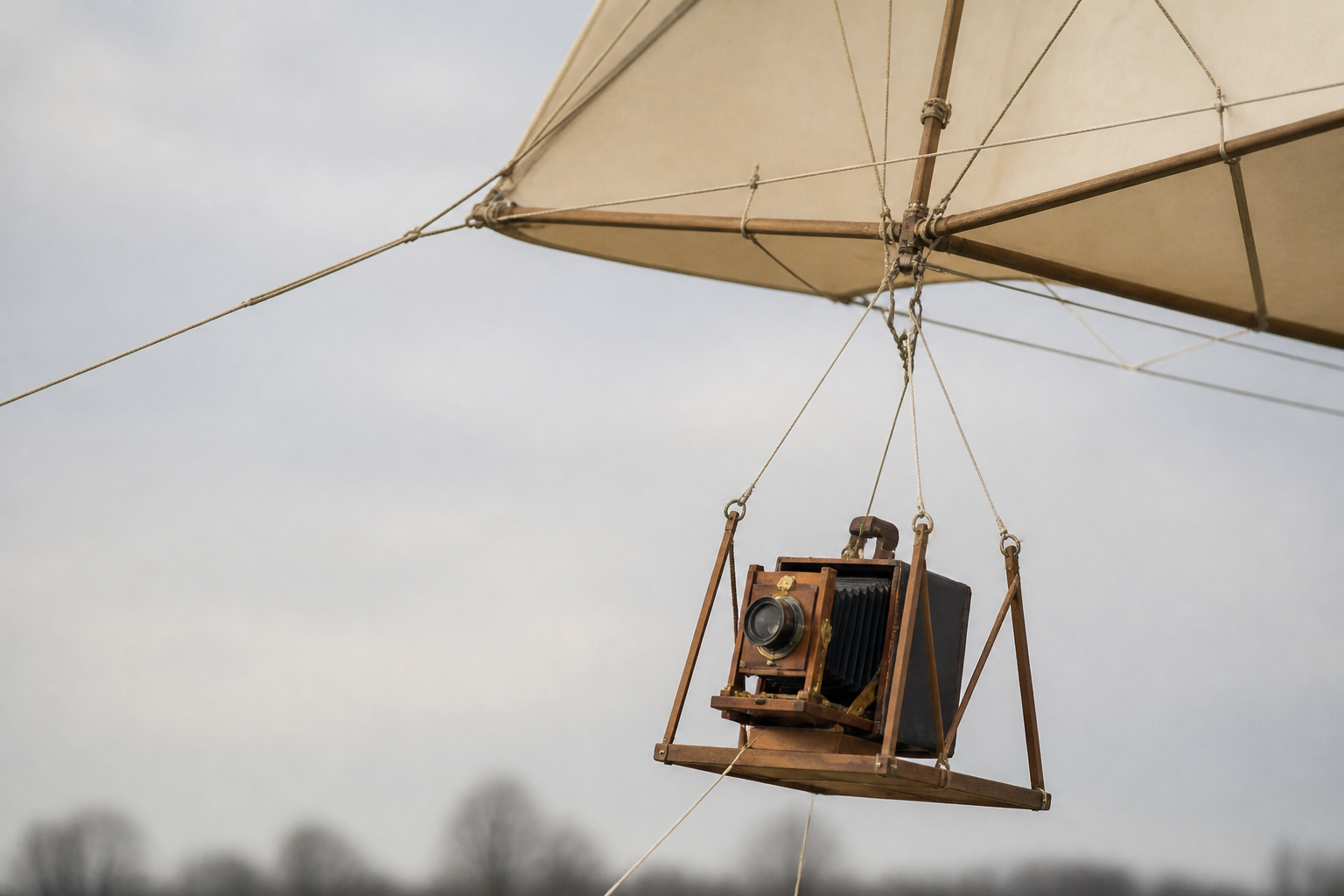
Balloons are expensive, and by the 1880s the alternative was obvious to anyone who had watched a kite pull. Arthur Batut flew a camera on a kite over Labruguiere in southern France in 1888, rigged with a slow burning fuse as a timer, and published a short treatise on the method two years later.3 Kite aerial photography has never really gone away since; it costs almost nothing, needs no fuel and no licence, and in archaeology it remained the standard way to photograph an excavation from above until very recently.
Its most famous product came out of a disaster. Six weeks after the San Francisco earthquake of April 1906, George R. Lawrence raised a large curved plate panoramic camera, weighing something like forty nine pounds, on a train of kites to roughly two thousand feet over the bay, and made a single negative about eighteen inches by forty eight showing the ruined city end to end.4 It is still one of the most technically impressive photographs ever made from a tether, and it was made because no aircraft existed that could have done it.
Every generation rediscovers that the cheapest way to get a camera up is to tie it to something that already wants to go there.
On kites, balloons and the recurring idea
Observation balloons, and the shape that stuck
The tethered balloon reached its technical maturity in war. Artillery observation from a stationary platform was worth an enormous amount, and the spherical balloons used at first were useless in wind. The answer was the elongated, finned, streamlined form that had already been worked out for airships, adapted to sit on a cable: it weathervaned, it was steady enough for a man with binoculars, and it is recognisably the shape of every camera aerostat since. Albert Caquot's design, introduced in the middle of the First World War, is the direct ancestor of the silhouette.5
After the war the mapping application moved decisively to aircraft. Photogrammetry became an industrial process, flown in straight overlapping lines at altitude, and the tethered platform was left with the jobs aircraft were bad at: low, slow, close and patient.
The quiet century
From the 1930s to the 2000s the tether kept a series of small, real niches, none of them large enough to build an industry on but all of them persistent.
- archaeological site recording, where a vertical photograph of a trench is worth a week of drawing;
- pole and mast photography for excavation, ecology and forensics, which needs no airspace permission at all;
- balloon and blimp platforms for architecture, real estate and event coverage in the film and early digital eras, filling exactly the gap between a ladder and a helicopter;
- cable suspended camera systems over stadiums, a different kind of tether solving the same problem of a camera that has to be somewhere no structure can reach;
- large military and border aerostats, which carry radar and communications rather than cameras and stay up for days.
2013, and what it ended
The mass market camera multirotor arrived in 2013 and the commercial framework in the United States followed in 2016. Within a few seasons the general case had moved: for most jobs the multirotor was faster to deploy, precise about position, repeatable, cheaper and legal to fly almost anywhere with a certificate and an authorisation. Balloon and blimp camera work, which had been a specialist trade with a genuine market, largely stopped being one.
What survived is the set of things a rotor cannot do: sit still for four hours, lift something heavy without noise, hold a long exposure at dusk, work inside a building. That is a real list, and it is the reason the technique is documented on this site rather than merely remembered. The practical version of it is the page on how a tethered camera session is run, and the honest comparison is on the platform page.
Notes
- Nadar photographed from a balloon over Petit Bicetre in 1858, having patented the idea of aerial photography for surveying and mapmaking in 1855. No image from the flight is known to survive. Back
- James Wallace Black, with the balloonist Samuel Archer King, October 1860, from roughly twelve hundred feet over Boston. Prints are held in major public photographic collections. Back
- Arthur Batut, Labruguiere, 1888, followed by his short published account of the method in 1890. Back
- George R. Lawrence, San Francisco in Ruins, May 1906. The dimensions and the camera weight are those usually cited with the surviving negative. Back
- Albert Caquot designed the streamlined observation balloon that became the standard Allied pattern from the middle of the First World War. The finned, elongated form is the reason a camera aerostat looks like a small airship rather than a sphere. Back